

Marketing is getting faster at producing things. The more interesting question is whether businesses are getting better at deciding what deserves to be produced.
Imagine a marketing team that used to take three days to put together a campaign. Someone introduces AI, and suddenly the first draft is ready in three hours. The emails are written, the social posts are lined up, the landing page copy is done and the campaign brief looks remarkably presentable. Everyone is delighted. The team has saved time. The marketing head has something to report. The agency has another campaign to execute.
And then somebody asks, “Great. What else can we launch this month?”
Before anyone has had a chance to examine whether the original campaign was worth running in the first place, the time saved has been committed to producing more marketing.
Welcome to one of the more interesting contradictions in modern marketing: we are getting exceptionally good at doing things faster, but we haven’t necessarily become better at deciding what needs doing. AI deserves credit for changing the economics of marketing execution. But somewhere between generating the first draft and celebrating the tenth campaign, we may be overlooking a much bigger opportunity. If technology can fundamentally change how much time routine marketing work takes, shouldn’t it also change how we organize marketing, where we invest our attention and how we define performance?
That is a more consequential question than which AI tool writes the best email.
AI adoption is moving faster than the rethink of marketing itself
Let’s begin with the numbers, because this isn’t a theoretical conversation anymore.
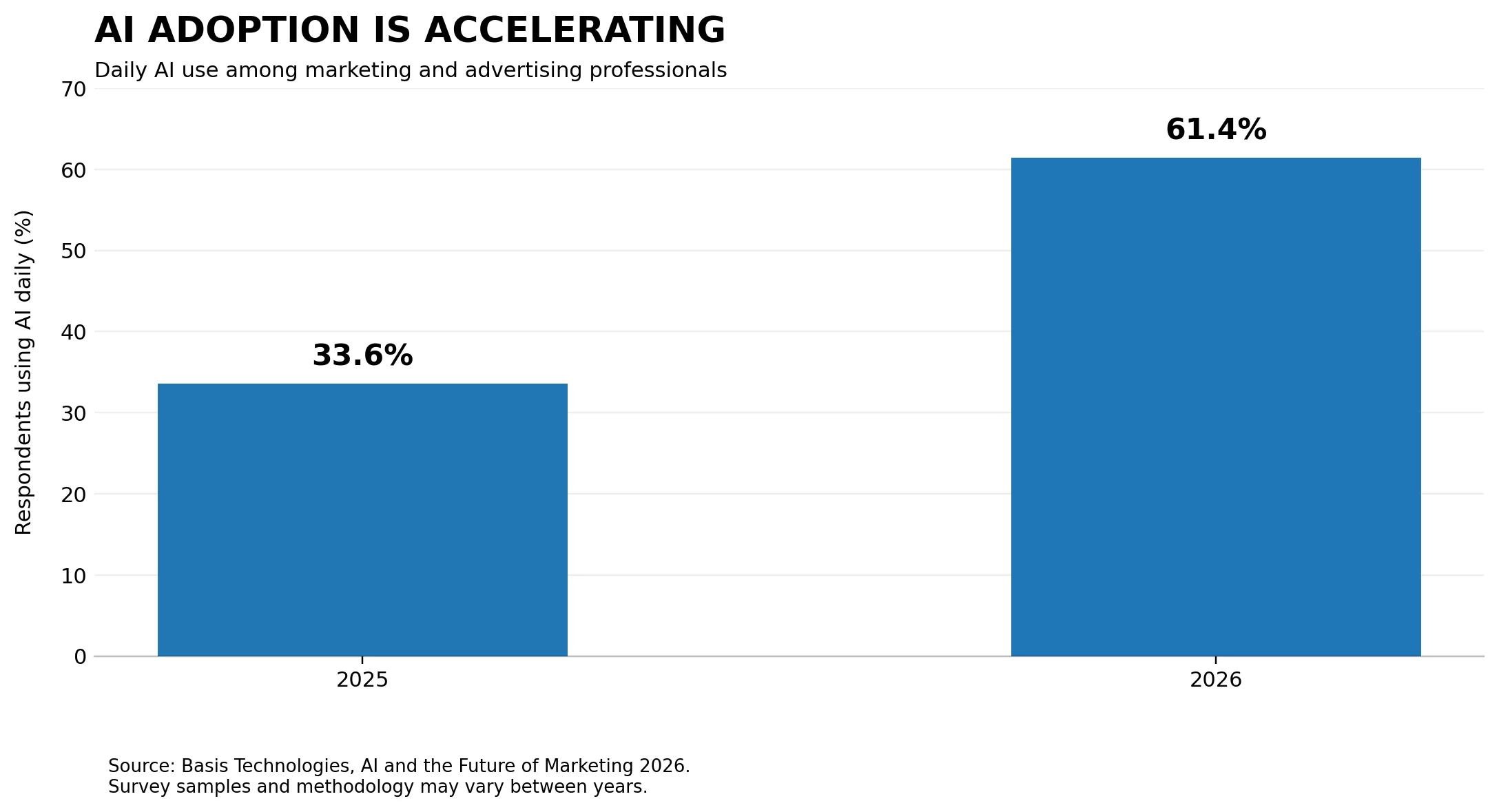
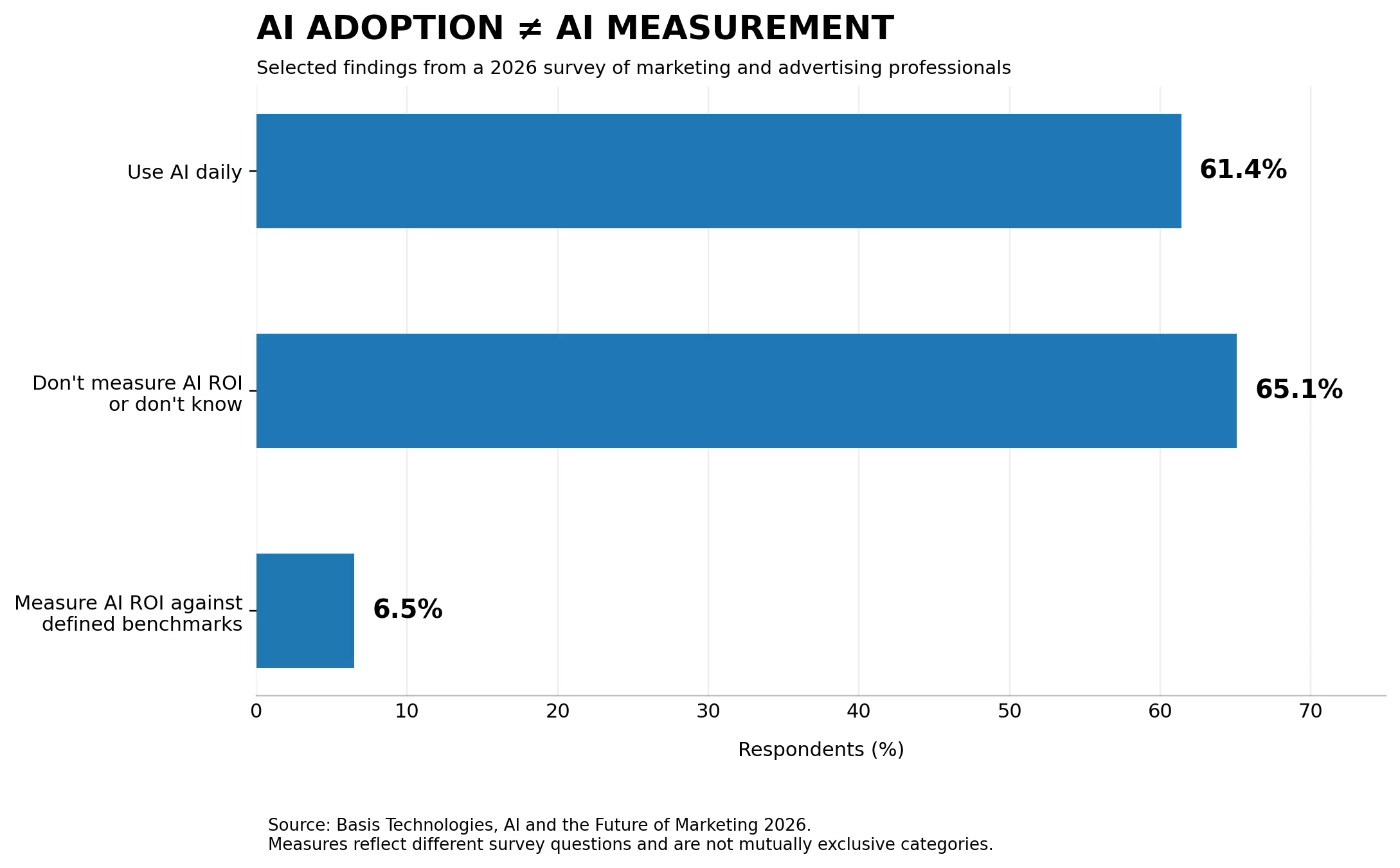
‘AI and the Future of Marketing research’, based on a survey of 184 marketing and advertising professionals, found that 98.4% of respondents used generative or agentic AI in their work. More strikingly, 61.4% reported using it daily, compared with 33.6% in 2025. That’s a significant change in just one year. AI is no longer an interesting experiment reserved for the enthusiastic person in the marketing team who likes trying new software. It is becoming part of everyday marketing operations. But another finding from the same research deserves considerably more attention: only 6.5% of organizations said they evaluated their AI investments against defined metrics and benchmarks. Meanwhile, 65.1% either did not measure AI ROI at all or didn’t know whether anyone in their organization did.
Read those numbers together. AI adoption is widespread, but rigorous measurement of the return on that investment remains uncommon.
There is an important distinction here. Measuring whether AI helps an employee complete a task faster is not the same as measuring whether it improves marketing performance. And measuring marketing performance is not the same as establishing whether the business is growing more profitably because of it. These are three different questions. They deserve three different answers.
Source: [Basis Technologies, AI and the Future of Marketing 2026].
The productivity trap: when faster becomes busier
Consider a B2B technology company with a small marketing team. Its responsibilities include website content, email campaigns, webinars, social media, paid advertising, sales collateral and a monthly performance report. Before AI, the team struggles to keep up. Content takes time, campaign development involves multiple rounds of feedback, and reporting consumes a disproportionate amount of everyone’s attention.
Then AI enters the picture.
First drafts are produced faster. Research summaries are easier to compile. Reports can be prepared with less manual effort. The team can repurpose a webinar into several content formats without starting from scratch every time. All of this is useful. But what happens next depends on how the organization operates. In one company, the team uses the time saved to speak with customers, examine lost opportunities, improve the website’s conversion journey and test a sharper value proposition. In another, the team doubles its publishing frequency, adds more campaigns to the calendar and creates additional reporting to demonstrate its newfound productivity.
Both companies have adopted AI. Both may report efficiency gains. Yet they are using that efficiency to pursue very different outcomes. The first is using technology to improve the quality of marketing decisions. The second is using technology to increase the volume of marketing activity. The difference isn’t the tool. It is the operating model around it. This is where marketing leaders need to be careful. When a team is rewarded for the number of campaigns launched, content published or activities completed, making execution faster will naturally encourage more execution. People respond to the incentives and expectations built into their jobs.
AI doesn’t automatically change those incentives. It can make them more expensive to ignore.
More content is not the same as more demand
The easiest place to see this problem is content marketing. AI has dramatically lowered the effort required to produce articles, social posts, email sequences, campaign variations and landing-page copy. For a team that has struggled with production capacity, this can be genuinely valuable. But production was never the only constraint in content marketing. The more difficult questions are still familiar:
- Does the content address a problem that matters to the intended buyer?
- Does it offer a perspective that is meaningfully different from what competitors are saying?
- Does it help a prospect understand the problem, evaluate a solution or make a decision?
- Does it reach the right audience through channels that audience actually trusts?
- Can we establish whether it contributes to qualified demand or sales conversations?
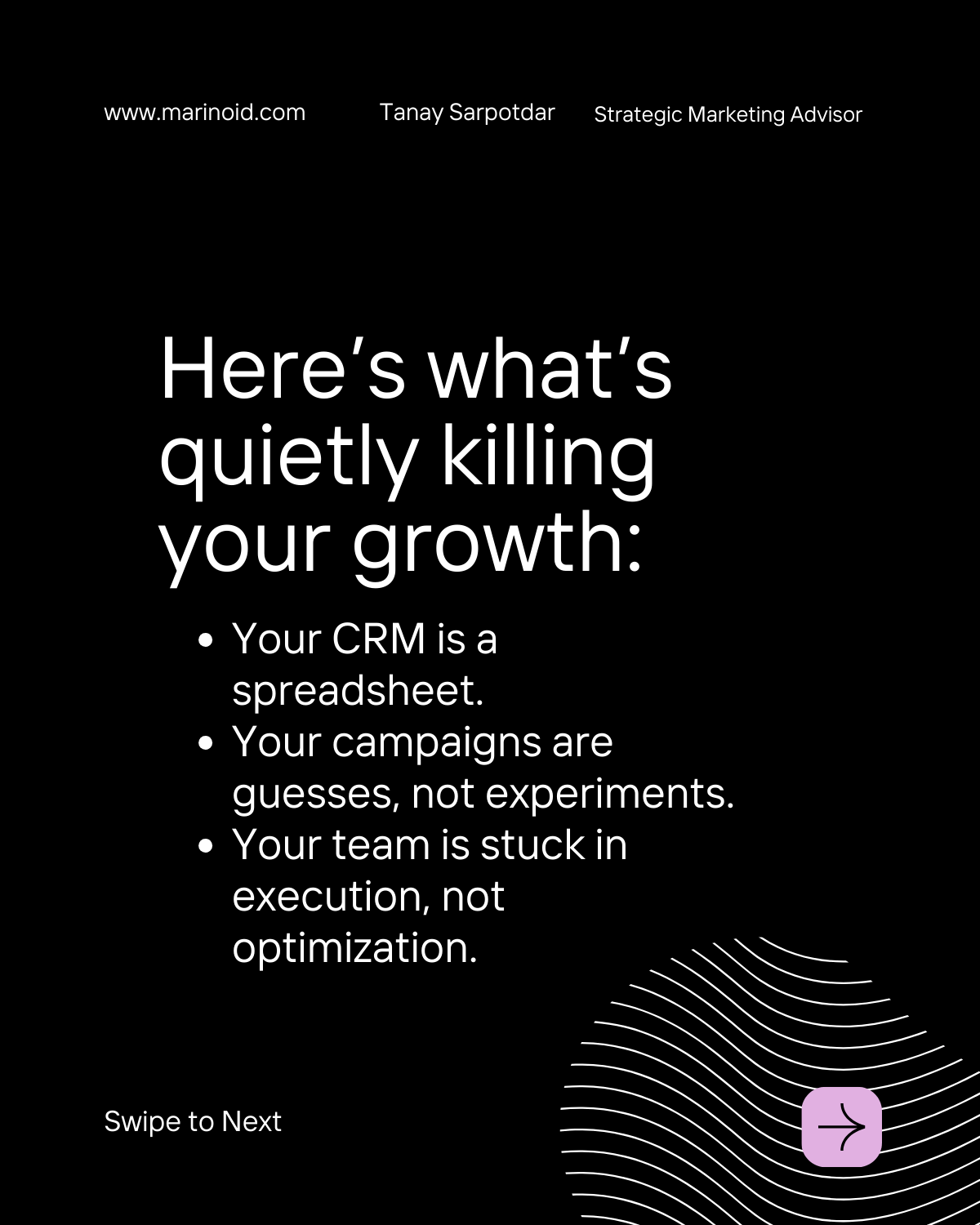
AI can help answer some of these questions. It can synthesize research, identify patterns in customer feedback and generate alternative approaches for testing. But those capabilities are useful only when the team asks the right questions and brings reliable evidence to the process. A company with unclear positioning can use AI to generate twenty versions of an unclear message. A company without a well-defined ideal customer profile can create highly polished campaigns for an audience it has not properly understood. The output may look better. The underlying marketing problem remains.
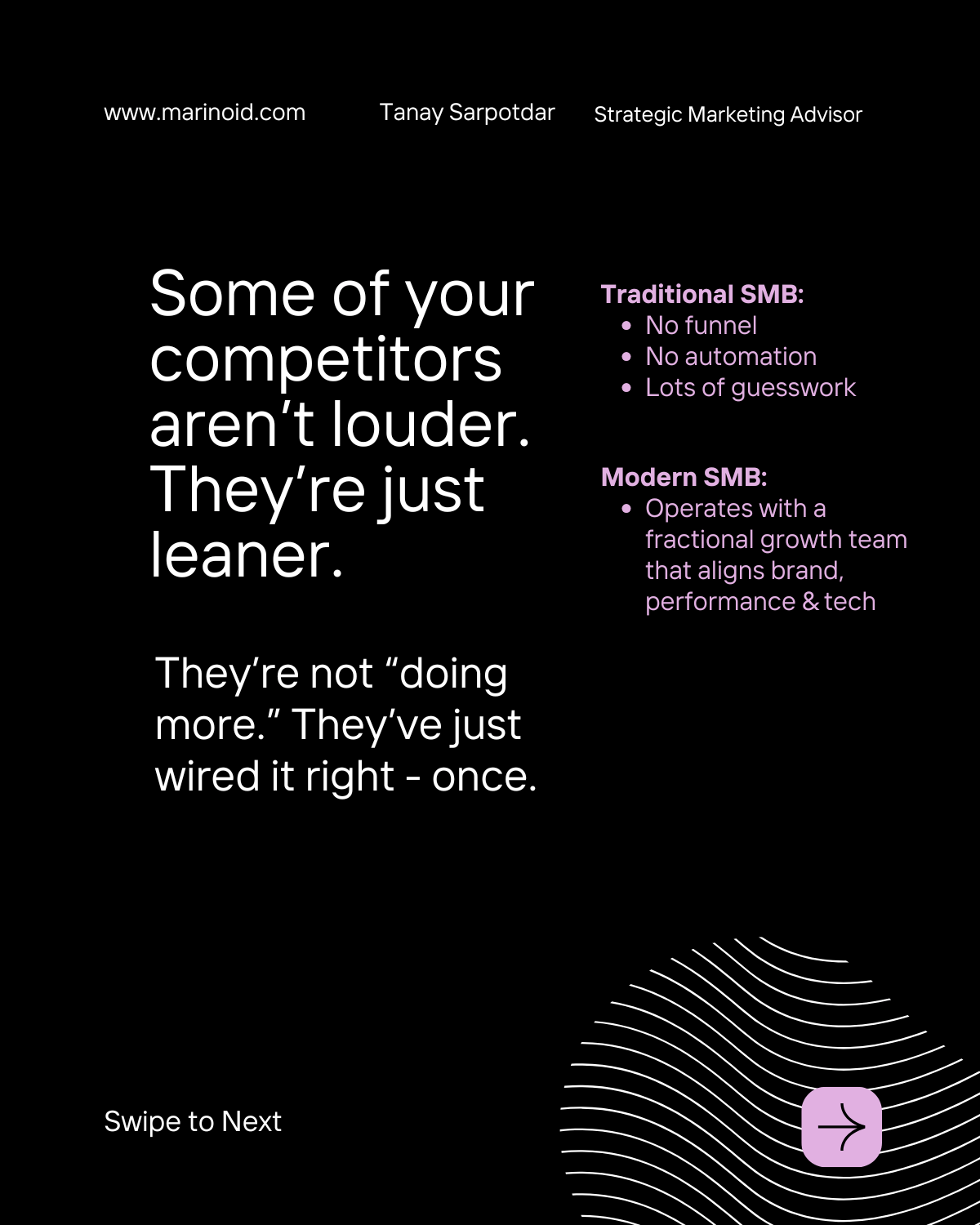
This is particularly relevant in B2B marketing, where buying decisions often involve several stakeholders, long evaluation cycles and significant commercial risk. A prospect rarely chooses a vendor because that vendor published more frequently than everyone else. They choose because the solution appears relevant, credible and capable of solving a problem worth paying to fix.
Content has a role in establishing that case. Content volume is not the case itself.
The work AI saves is not automatically the work that matters
One of the most useful ways to evaluate AI in marketing is to distinguish between the time spent producing work and the time spent improving the decisions behind it. The first category includes drafting, formatting, summarizing, repurposing and routine reporting. Much of this work can be accelerated, although the extent of the gain varies by task, workflow and quality requirements.
The second category includes understanding customers, making positioning choices, evaluating competitive alternatives, deciding which markets to prioritize and determining why prospects fail to convert. These activities also benefit from AI, but they require judgment, context and accountability. A generated summary can help a team understand customer interviews. It cannot replace the decision about which customer problem the business should build its positioning around.
The opportunity is to move capacity from repetitive production towards higher-value work.
Yet that shift will not happen automatically. It requires marketing leaders to decide which activities should be automated, which should be eliminated, which need human judgment and which deserve more investment once capacity is released.
That is an operating-model decision, not a software decision.
What the latest research tells us about the gap
The 2026 Basis study offers a useful illustration of the difference between adopting AI and redesigning how marketing operates.
Three findings stand out:
- 61.4% use AI daily – AI has become a routine part of work for a large majority of surveyed marketing and advertising professionals.
- 51.1% report that their marketing organizations use AI agents – Adoption is moving beyond individual prompts into workflows that can undertake more complex tasks.
- Only 6.5% evaluate AI investments against defined metrics and benchmarks – The discipline of measuring the return remains far less widespread than adoption itself.
These figures come from one industry survey, not every marketing organization. They should not be treated as universal benchmarks. But they point to a question worth asking in any business investing in AI: are we measuring the presence of the technology, the productivity it creates, or the commercial outcomes it helps deliver?
Those measurements belong at different levels.
A team might track how long it takes to produce a campaign brief. A marketing leader might track whether that change improves campaign throughput without compromising quality. The CEO should ultimately care whether the broader investment contributes to stronger pipeline, better conversion, lower operating costs or another clearly defined business outcome.
Without that distinction, organizations risk celebrating an operational improvement without understanding its commercial value.
The real opportunity is to redesign the marketing operating model
An operating model is not an elaborate organizational chart or a document that sits in a shared drive. It describes how marketing actually works: how decisions are made, how priorities are chosen, how responsibilities are allocated, how teams collaborate and how results are measured.
AI gives businesses a reason to revisit those choices.
- Rethink what gets prioritized – If routine execution takes less time, the team should have a more deliberate process for deciding where to invest the capacity released. That might mean better customer research, more focused experimentation, improved sales enablement or a deeper examination of the conversion funnel. The question should not be, “What else can we produce?” It should be, “What is currently preventing us from making progress?”
- Rethink how marketing work flows – Many marketing delays have little to do with writing or design. They come from unclear briefs, repeated approvals, fragmented ownership, disconnected systems and late-stage changes. Automating a broken process may accelerate individual steps while leaving the overall process inefficient. Before introducing AI into a workflow, examine why the workflow exists, where work gets stuck and which steps could be removed altogether.
- Rethink the division of responsibility between people and AI – AI can support research, analysis, content development and execution. People still need to establish objectives, assess evidence, make trade-offs and take responsibility for decisions. The goal is not to preserve every existing task for humans. Nor is it to automate everything possible. It is to allocate work according to where technology is effective, where human judgment adds value and where the consequences of error require additional controls.
- Rethink how marketing performance is evaluated – If a team becomes more productive, its performance measures should not stop at output. Measure the operational gains, but connect them to meaningful marketing indicators: qualified opportunities, conversion rates, campaign contribution, sales-cycle progression and the cost of generating demand. Not every marketing activity produces an immediate sale, and attribution is rarely perfect. The objective is to build a credible line of sight between investment, activity, customer response and business results.
- Rethink how marketing works with sales – AI can help marketing analyze customer questions, summarize sales conversations and identify recurring objections. Those insights are more valuable when they inform the wider go-to-market process. If marketing learns that prospects consistently misunderstand the product’s value, that finding should influence messaging and sales enablement. If good leads are being lost because follow-up is slow or qualification is inconsistent, producing more leads may not be the highest-priority intervention. The opportunity is to use better information to improve the entire customer journey, rather than optimize marketing activity in isolation.
A practical way to put this into action
For a business that has already started using AI, the next step does not have to be another technology project. It can begin with a straightforward review of how marketing work gets done. Start by mapping the team’s recurring activities. Identify where time goes, where work gets delayed and where the same information is repeatedly recreated. Establish which tasks are candidates for automation and which consume time without contributing enough value. Next, identify the business outcomes the marketing function is expected to influence. These will vary by company, but could include qualified pipeline, website conversion, customer acquisition cost, expansion revenue or retention. Then select a small number of workflows to redesign. Establish a baseline, introduce the change, measure the result and assess whether the improvement is worth scaling.
Finally, decide what should happen to the capacity released. This is the step that often gets missed. If a workflow saves the team time, explicitly determine whether that time should be redirected to customer research, experimentation, strategic planning or another priority. Otherwise, the organization may simply absorb the savings into a longer activity list. The objective is not to build the most automated marketing department. It is to build a marketing function that makes better decisions, uses its resources intelligently and contributes more effectively to business growth.
What this means for marketing leadership
For a marketing leader, the arrival of AI creates a responsibility that extends beyond tool selection and adoption. Someone must decide which processes need to change, which capabilities the team needs to develop, how quality will be maintained and what success should look like. Someone must also challenge the assumption that a team producing more work is necessarily creating more value. These are leadership questions because they involve priorities, incentives, accountability and investment. They also require a degree of restraint. Not every task needs AI. Not every workflow needs an agent. Not every efficiency gain justifies a larger volume of output. Sometimes the right decision is to automate. Sometimes it is to simplify. Sometimes it is to stop doing something altogether.
The value lies in knowing which response the business actually needs. For companies without a full-time senior marketing leader, this can be particularly important. A fractional CMO can help connect AI adoption to positioning, demand generation, sales alignment and the wider marketing operating model, ensuring that technology investment supports a coherent growth strategy rather than becoming another disconnected initiative. The starting point is not a list of tools. It is an honest assessment of how marketing currently works and what needs to improve.
The question worth asking next
AI has made it easier to produce marketing. That is a real advantage, and there is little point pretending otherwise. But production capacity was never the only thing separating effective marketing from ineffective marketing. Customer understanding, strategic clarity, sound prioritization, disciplined execution and the ability to learn from results have always mattered. If anything, making production cheaper increases the importance of those capabilities. When almost any business can generate another campaign, the ability to decide which campaign is worth running becomes more valuable.
So perhaps the most useful question for marketing leaders is not how much time AI has saved, how many tools the team has adopted or how many new campaigns it can launch. It is what the business will do differently because that capacity now exists.
Will it understand its customers better? Make sharper strategic choices? Improve the buying experience? Invest more intelligently? Build a more connected relationship between marketing and sales?
Or will it simply produce more?
At Marinoid, we believe the conversation needs to move beyond AI adoption towards how marketing is designed to drive growth. Technology can improve execution, but its value depends on the strategy, processes and decisions surrounding it. The real return on AI may not be the work it helps marketing eliminate. It may be the better work marketing finally has the capacity to do. And if the way marketing operates remains unchanged, we may discover that the biggest thing AI has saved us is time to fill with more work.
About the Author: Tanay Sarpotdar

FAQs
Marinoid has a different grammatical meaning. We coined it from two words viz Marketing + Droids. A futuristic approach to marketing. Our mascot ‘Noidy’ is designed and inspired by the movie, WALLE and shares the same emotional quotient.
You will get a call from us within 24 hours or when you have scheduled a call. First meeting focuses on understanding your business problem and/or marketing request. We will brainstorm the need and discuss how to approach it. If you like the approach, we will discuss the commercials and kickstart the journey.
Digital Marketing is not magic. It is a science and art. Besides, there are various factors which decide ‘success’. Treat marketing as an investment centre rather than a cost centre. Understand and brainstorm as much as possible before committing to the plan.
A wise man once said – “If you throw peanuts, you will only attract monkeys!” At Marinoid, we focus on helping you achieve GTM first rather than focusing on our profits – so don’t worry we will help you regardless.
In simple terms, your website – your most critical asset. Focus most of your efforts on making this asset robust, scalable and simple. It should be your best replacement on the web and all your efforts should be circled around this asset.
Yes, there is an hourly charge for consultation. Check our pricing page or drop us a note and we will tell you the details.


Recent Posts:

AI Didn’t Give Marketing More Time. So Where Did the Time Go?
Marketing is getting faster at producing things. The more interesting question is whether businesses are getting better at deciding what deserves to be produced. Imagine a marketing team that [...]

The Economics of Borrowing a CMO
There is a strange thing happening in marketing. A growing company can have a great product, a capable sales team, a decent marketing budget and a long list of [...]
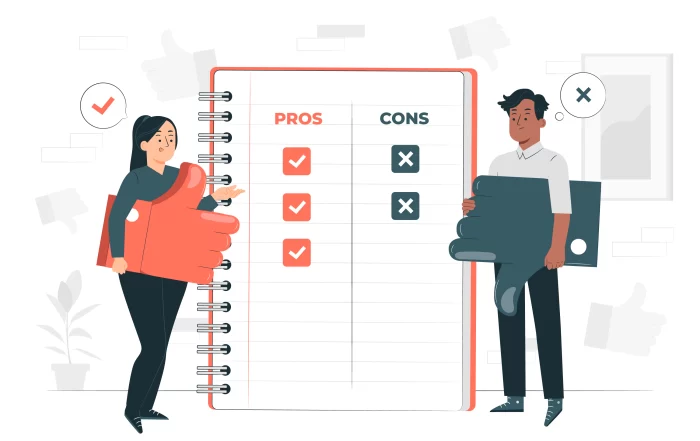
The New Marketing Realities: What Worked Yesterday Won’t Necessarily Work Tomorrow
Marketing has always changed. New channels arrived. Old channels disappeared. Consumers changed habits. Algorithms changed. Martech exploded. Marketers adapted. But what is happening now is slightly different. The fundamentals [...]

The Half-Life of Certainty: Why Great Leaders Know When to Let Go of Being Right
History has an amusing habit. It makes yesterday's certainty look almost comical. There was a time when experts believed the internet would never become mainstream. Mobile phones were considered [...]